Three New Members Join Project ReShare Steering Committee

The Project ReShare Steering Committee welcomes its three newest members after our latest round of elections for at-large members. The newly elected members are Kristen Calvert (Western Carolina University), Pamela Jones (ConnectNY), and Zheng Ye (Lan) Yang (Texas A&M).

Kristen Calvert is currently the Department Head for Discovery and Technology Services at Western Carolina University. For the past 10 years, Kristen has worked with e-resources, collections, technology, and resource sharing. Kristen has been an active member of the UNC Shared ILS task force and serve on the Consortium of Shared UNC Print steering committee. As the past Content Organization and Management Department Head, Kristen was responsible for WCU’s ILL unit and migrated WCU from ILLiad to Tipasa in 2018. Kristen’s new responsibilities include Project Management for technology projects, including our migration to a new content management system for digital collections.

Pamela Jones is the Executive Director of ConnectNY, a consortium of independent academic institutions in New York State. Pam has over 37 years of experience in public, academic, and special libraries in addition to her work with ConnectNY. Pam currently serves on the CC-PLUS Steering Committee, the Partnership for Shared Book Collections Operations Committee, the Empire Library Delivery Advisory Committee, and the Empire Archival Discovery Cooperative Advisory Committee.  She is an experienced editor, writer, presenter, communicator, and consultant, as well as an avid gardener.

Zheng Ye (Lan) Yang is the Director of Document Delivery Services at Texas A&M University Libraries. She was responsible for planning and implementing the popular Get It service, and has developed innovative and responsive services for faculty and students that have become models for other institutions worldwide.  Because of her pioneering work, she is frequently consulted by peer institutions and invited to give presentations across the nation about interlibrary loan/document delivery services.  As the interim Associate Dean for Document Delivery/Interlibrary Services, Collection Development, Electronic Resources, Acquisition, Cataloging, and Stacks Maintenance, she worked with collections and technical services to coordinate alignment of library services with current campus research and teaching needs.  She is an advocate for the resource evaluation, delivery and discovery processes that connect the TAMU community members to information resources.

ReShare Implementation: An Interview with Jill Morris, Executive Director at PALCI

PALCI went live with ReShare Returnables in August 2021. Clara Fehrenbach, Document Delivery Services Librarian at the University of Chicago and ReShare Communication Team member, interviewed PALCI Executive Director Jill Morris about the implementation.

Photograph of Jill Morris

Project ReShare: When did PALCI go live with ReShare Returnables?
Jill Morris: PALCI went live with ReShare powering its well-known EZBorrow consortial interlibrary loan service on August 12th, 2021. Within just a few short days, we were already seeing requests being generated through our patron search/browse interface (the shared VuFind ReShare discovery layer) and books being delivered to borrowing PALCI institutions. The first patron-initiated ReShare book request to make its way into the hands of a library patron originated at Dickinson College in Carlisle, PA. The item was supplied and delivered by Drexel University in Philadelphia in less than 48 hours. The system correctly identified Drexel University as a supplier for the item, and the staff at Drexel processed the request in ReShare, getting the book to the user even more quickly than most Amazon Prime purchases.

Kacey Feduke holds up the first book received through ReShare
Kacey Feduke of Dickinson College receives the first book for a patron less than 30 hours after going live with ReShare.

PR: What features of ReShare are most exciting for PALCI?
JM: From the consortium office perspective, we’re thrilled to have the means to support library configurations with a central directory and other staff-facing tools that support easy problem solving and troubleshooting. We can see what’s happening with each request from the moment the patron clicks a button, and while it’s hidden from patron-view, staff can use that information to ensure the system is working properly behind the scenes. We also love the new shared index that was developed as a part of this system to support the sharing of collections. At a glance, we can search and understand what’s held collectively within the PALCI community. 

PR: What are you hearing from member libraries about ReShare?
JM: Library staff are telling us that they like the opportunity to communicate back and forth with each other, right at the point of need. A message feature allows you to connect with the individual working on a specific request without the need for separate email chains and reference back to other systems. We’re also hearing that many faculty users enjoy the discovery interface where they can browse for and filter searches to identify the materials they’re seeking at our 50+ participating EZBorrow libraries.

PR: What has your experience been like leading up to your implementation?
JM: PALCI decided to join the ReShare community prior to it having the name ReShare. For two years prior to ReShare’s official start, a working group within PALCI made up of resource sharing experts, library developers, systems staff, and consortial leadership had put a great deal of effort into identifying and defining a preferred future for next generation resource sharing. In early 2017, it was determined that threats of market consolidation were increasing, and that there was no existing system that would meet the needs of the future defined by that group, so we began seeking out partners to create solutions. The group agreed that it was essential for our choice to include an investment in open and interoperable library infrastructure so as not to repeat the same issues of the past, and so that the end result would remain under the control of the community that developed it. After making our initial contribution to help co-fund the UX design and development work, the decision to implement ReShare was an easy one. We had played a role in designing the system’s requirements, and ReShare represented the potential for innovation and the future our community had defined several years earlier.

The implementation of the system itself was mostly front-loaded with steps to ensure we could properly map the holdings of each library’s collections into our shared index so they could act as suppliers in the system. Setting up the cloud-based tenants for each library was a relatively straightforward process. Our service provider, Index Data, hosts and maintains the implementation. Each library received its own distinct URL and login to set up its staff users. Once set-up, libraries were able to configure their institution’s pickup locations and prioritize various locations and branches as suppliers. The ReShare interface gives our consortium staff tools to help configure the settings for each library, and because most of our libraries already had standard NCIP functionality in place (a set of protocols that allows a central system to talk to disparate ILS systems), we were primarily working through an iterative process of configuration and testing.  We have at least 12 different types of ILS systems in use by PALCI libraries, plus a variety of discovery tools.  ReShare’s use of standards, like NCIP, and open APIs, allowed us to connect to each ILS seamlessly, and in the future, the system will be capable of discovery integrations with local systems too.  

 We were determined to go live with our implementation just prior to the start of the Fall semester to ensure we’d have enough staff back in the office. The launch also coincided with many staff returning to on-site work after more than a year of COVID-related disruptions. We also waited to make sure that ReShare integrations with other tools, like ILLiad, were well on their way to completion. Our biggest hurdle was the sheer volume of institutions we needed to connect, and the many system configuration combinations those libraries represented.The implementation was fast and furious as we approached our target date — PALCI was the very first implementer to go live, and as we went along, we identified some configuration issues that needed resolution prior to implementation. Fortunately, the ReShare development team delivered on solutions each time we encountered a problem, and none of the issues prevented us from using the system. We managed the implementation largely in cohorts, and relied on our community to help support each other in developing system documentation and user guides that will benefit other consortia in future. Today, we have 53 libraries actively using ReShare, and we expect to bring on 15-20 additional libraries in the next 6-12 months. 

PR: What advice do you have for others considering ReShare?
JM: With most proprietary platforms, libraries have to expect that commercial business interests will ultimately win out in all product roadmap decisions, driving further vertical vendor integrations and less choice in the marketplace overall. After all, commercial entities offering proprietary solutions are set-up to operate for profit, whether or not the solutions that drive that profit are actually benefiting users of the service to the fullest extent desired by consumers. ReShare represents an important opportunity to break that cycle and give libraries a real voice in the process. It’s a chance for libraries to co-invest in and shape the future of sharing collections by providing choice and potential for innovation — keeping libraries’ and patrons’ needs front and center through a shared vision and governance model. ReShare is a brand new software – and there are some growing pains that come with that choice. The software is not yet as mature as others out there on the market. Yet the system is breaking new ground with its implementation of ISO18626 — the newest ILL standards, and it’s laying a foundation for greater system interoperability in the future.  It’s an investment that all libraries should be thinking hard about making when faced with the choice. Along those same lines, I think perhaps ReShare’s most important asset is its community. The team of developers from Index Data and Knowledge Integration together in partnership with a group of consortia and individual libraries is unlike most library community projects in that we have a deep wealth of expertise, transparency, shared interests and alignment around vision. 

Recording and Slides from the October 2021 Project ReShare Open Community Meeting

We’re pleased to share the recording and slides from Project ReShare’s October 14th open Community Meeting.

In this meeting, Pam Jones (Connect New York) and Jill Morris (PALCI) explained their decisions to adopt ReShare Returnables for their consortia. From a practitioner point of view, Maureen O’Brien Dermott (Dickinson College), Liz King (Rensselaer Polytechnic Institute,) and Michele Matthews (Rensselaer Polytechnic Institute) talked about their experiencing implementing and using ReShare Returnables.

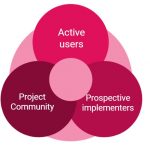
Graphic showing relationship between active users, project community and prospective implementers.  They overlap and join in the middle.

Kristin Wilson (Index Data) talked about the relationship between ReShare service providers and libraries/consortia implementing and using ReShare Returnables.

Finally, Kelly Farrell (TRLN) shared ways that Project ReShare community members can get involved with the project.

ReShare Implementation: An Interview with Pam Jones, Executive Director at ConnectNY

Photo of Pam Jones

ConnectNY implemented ReShare Returnables in September 2021. Jon Jeffryes, Interim Associate Dean at Grand Valley State University and ReShare Communication Team member, talked with ConnectNY Executive Director Pam Jones about the implementation.

Project ReShare: When did ConnectNY go live with ReShare Returnables?
Pam Jones: September 1. It’s been a little over two weeks.

PR: What features of ReShare are most exciting for ConnectNY?
PJ: The fact that it’s open source and we can have some agency in the development of it going forward. That was huge for us.

PR: What are you hearing from member libraries about ReShare?
PJ: So far, so good. Of course, any time you do implementation you can test all you want in a testing environment and when you go to production it’s always different. Originally, we were going to implement and go live in mid-August but when PALCI [Partnership for Academic Library Collaboration & Innovation] went live the week before us, there were issues that came out. So, we put ours off for two weeks while those bugs were fixed and those issues were addressed. Then when we went live.

The first week or so, there were a lot of messages about “This isn’t working,” and “I don’t know how to do that.” We got through those and it’s — knock on wood – it’s calmed down this week. But I just saw two emails asking questions, so we’ll see. But we’re getting through it and it seems to be working. Patrons are using it. That’s the bottom line, that that’s working.

PR: What has your experience been like leading up to your implementation?
PJ: Well we were on INN-Reach, Innovative’s product, for the last twenty years, and we needed to exit that, so we did that. We talked with Index Data, the board approved moving to ReShare in late 2020, and I got contracts signed in late December/early January. Then we started the implementation process with Index Data while we were exiting from INN-Reach. So, it was a little hairy for a while, exiting one product and starting to implement another. There is a process to exiting INN-Reach; we wound down circulation and exited. That went very smoothly.

In the implementation, the biggest hurdle for us, was our Sierra and Millennium libraries did not have the NISO Circulation Interchange Protocol (NCIP) API added, so they all decided to do implement that. You don’t have to, but it does make things work with your system. It took us a while but the Director of Support Services at Innovative helped us get all of NCIP APIs up and running. That was probably our biggest hurdle, getting all the NCIP set up.

And then getting SSO set up for everybody took a bit of work for the Index Data staff. At most institutions you have to work with your IT department and the library, and in our case, Index Data. They did it and we’re all up and running. We have resolved all but one NCIP issue, which actually had been resolved and now it’s not working again. So, we’re working on that one between Innovative and Index Data and it will get resolved. We’ll figure it out. “It’s brand new,” that’s what I tell everybody. It’s not going to be perfect and we will figure it out.

PR: Other than the NCIP APIs were there any other things you had to deal with around working with different libraries?
PJ: What was nice for us was that we use Basecamp for all of our committees and projects. So, I set up a Basecamp for the systems folks and then I set one up for, what we call the trainers – your practitioners, front line folks. When we were getting everything set up the implementers, the systems Basecamp was super busy. We have staff from Index Data on the Basecamp projects and when there were questions, they helped answer them. We’re going to move away from that pretty soon, but for implementing it worked. There were a lot questions and it was nice because my crew — there’s a lot who are on Alma, and some on Sierra, there’s one on Millennium, there’s one WMS — the Sierra folks would ping and help each other. The same with the ALMA users. They were sharing their settings and knowledge and we got everything figured out. The nice thing is that it actually does work with all the different systems. It gives everybody the same experience.

PR: What advice do you have for others considering ReShare?
PJ: Plan your support for after implementation. Talk to your service provider if you’re not going to be your own host and make sure that you’re able to handle it. Know that it is different and there are going to be a lot more issues maybe than you’re used to. We increased the hours for our members service coordinator recently just to help us going forward with that, because we’re just two part-time people, we’re a small shop.

News Release — GALILEO Initiative Joins Project ReShare

September 21, 2021

The inclusion of GALILEO as a new member of Project ReShare dramatically increases the number of institutions affiliated with the project. GALILEO, Georgia’s virtual library, is a community of more than 2,000 institutions, including colleges, school districts, and public libraries. . Project ReShare is pleased to welcome GALILEO to the rapidly growing ReShare community. Current ReShare membership is available on the Project ReShare web site. Information about GALILEO, its programs, and  membership is available at https://about.galileo.usg.edu.

An initiative of the Board of Regents of the University System of Georgia (USG), GALILEO offers many programs to its community, including GALILEO Search, Affordable Learning Georgia, the Digital Library of Georgia, and GALILEO Interconnected Libraries (GIL). “We’re pleased to begin working with ReShare,” remarked Lucy Harrision, Assistant Vice Chancellor for Academic Library Services and Executive Director of GALILEO. “While we don’t yet have a specific timeline for implementation, we’re very optimistic about the prospect of an open source resource sharing application. We look forward to working with ReShare leadership to develop a roadmap and expand our portfolio of services to the GALILEO community.”

In addition to paying an initial membership fee, GALILEO will be offering in-kind support by way of accessibility audits and testing by staff who have received training from the Center for Inclusive Design and Innovation at Georgia Tech. Other in-kind offerings include provision of user stories for multi-type consortia as well as consultation on governance models. As a roadmap and timeline for adoption becomes clearer, GALILEO hopes to provide additional support and increase its investment further.

“The ReShare leadership has already benefited from our initial conversations with GALILEO about how they might contribute to and benefit from participation in the project,” said Tim McGeary, Associate University Librarian for Digital Strategies and Technology at Duke University Libraries and chair of the Project ReShare Steering Committee. “We look forward to integrating the GALILEO team into the ReShare community.”

The ReShare Community recently celebrated an important milestone with the launch of ReShare Returnables by two long-standing consortial members, PALCI and ConnectNY.

 Background

The ReShare Community is a group of libraries, consortia, information organizations and developers, with both commercial and non-commercial interests, who came together in 2018 to create Project ReShare – a new and open approach to library resource sharing. The ReShare Community has a bold vision for building a user-centered, app-based, community-owned resource sharing platform for libraries to set a new standard for how we connect library patrons to the resources and information they require.

For more information, contact info@projectreshare.org.

To receive email updates from Project ReShare, please sign up for the Project ReShare news list at https://projectreshare.org/contact.

News Release — ConnectNY Launches ReShare Returnables

ConnectNY, a consortium of independent academic institutions in New York State, launched ReShare Returnables on September 1, 2021. ConnectNY follows closely on the heels of the PALCI consortium, which implemented ReShare Returnables in August. 

The Board of Directors of ConnectNY was looking for a different product to support resource sharing when ConnectNY joined the ReShare community in 2019. Pamela Jones, ConnectNY’s Executive Director, remarked, “We are excited and proud to have implemented ReShare already. Our consortium is small, but our membership is willing to take risks to improve services and programs. Choosing to work with Index Data made the move to ReShare possible for us.”

Jones also commented on the appeal of supporting an open source project like ReShare. “It is exciting to be a part of an open source community where our ConnectNY members have a say in the ongoing development of a product.”

Tim McGeary, chair of the Project Reshare Steering Committee, congratulated ConnectNY on its successful launch. “The ConnectNY team worked closely with Index Data to ensure a smooth transition to Project ReShare,” McGeary said. “On behalf of the Steering Committee, I’d like to express my congratulations and gratitude to ConnectNY for being a pioneering implementer of ReShare Returnables.”

ReShare Returnables supports interlibrary loan of physical materials between members of a consortium. The software, built using the open source FOLIO platform, uses an app-based approach to resource sharing workflows. Index Data and Knowledge Integration are lead developers on the project, with numerous members of the ReShare community also contributing to development. The apps include a member directory, queues to manage requesting and supplying workflows, and a bulk update tool. A shared inventory app allows ReShare libraries to pool their bibliographic metadata for discovery and fulfillment purposes.

More information about the Returnables product and a video demonstration can be found at https://projectreshare.org/products/product-demo

Background

The ReShare Community is a group of libraries, consortia, information organizations and developers, with both commercial and non-commercial interests, who came together in 2018 to create Project ReShare – a new and open approach to library resource sharing. The ReShare Community has a bold vision for building a user-centered, app-based, community-owned resource sharing platform for libraries to set a new standard for how we connect library patrons to the resources and information they require. 

For more information, contact ​info@projectreshare.org​.

To receive email updates from Project ReShare, please sign up for the Project ReShare news list at https://projectreshare.org/contact.

###

Media Contact

Lisa Croucher
Triangle Research Libraries Network (TRLN): trln.org, Executive Director
Project ReShare: projectreshare.org, Communication Team, Chair
info@projectreshare.org

News Release — ReShare Returnables Launched by PALCI

On August 12, 2021, the ReShare Returnables software went into full production, actively supporting the resource sharing needs of the PALCI consortium, including more than 50 diverse academic libraries located in PA, NY, NJ, and WV. This inaugural launch of ReShare Returnables marks almost exactly three years since a group of visionary open source software developers and consortial leaders met at Swarthmore College near Philadelphia, PA to chart the path of this innovative and inspirational project.

“We are thrilled to be the first library consortium to launch what is now the world’s first community-owned open source consortial borrowing system. ReShare will transform our ability to share our libraries’ collections and innovate in ways that will serve our patrons for years to come,” says PALCI Executive Director Jill Morris.

Morris has been a strong advocate for and leader of Project ReShare since its inception, having served as the inaugural chair of the Project ReShare Steering Committee. 

“It’s incredibly rewarding to see the hard work of so many people over the past three years coming to fruition. It’s been a great honor to participate in this project with so many of my colleagues, and I’m proud of what it represents, especially as it offers a sustainable model for successful open source software collaborations across sectors and organizations.”

ReShare Returnables is the first production software to come out of the open source, collaborative community. The Returnables software represents the first step in ReShare’s goal of creating a consortial resource sharing system that will enable sharing of the collective collection in all formats, regardless of integrated library system, and empowering library-driven and user centered workflows. 

In an average year, PALCI libraries borrow and lend more than 150,000 physical items from their collections to each other through PALCI’s well-regarded EZBorrow consortial borrowing program. EZBorrow, powered by the ReShare software, allows patrons to send borrowing requests to lending libraries automatically without involving library staff, saving staff time and giving patrons efficient, world-class access to more than 10 million unique items across the consortium’s shared collections.

ReShare Returnables supports interlibrary loan of physical materials between members of a consortium. The software, built using the open source FOLIO platform, uses an app-based approach to resource sharing workflows. The apps include a member directory, queues to manage requesting and supplying workflows, and a bulk update tool. A shared inventory app allows ReShare libraries to pool their bibliographic metadata for discovery and fulfillment purposes.

“ReShare is the result of a deep, open collaboration between a group of libraries, consortia, and companies, based on the notion that infrastructure should be owned by communities, not by individual organizations,” said Lynn Bailey, Chief Executive Officer of Index Data, the first certified service provider for Project ReShare. “This project has inspired and motivated us at Index Data in ways we could not have imagined, and it’s been a privilege to be part of it. We’ve developed a complete set of services that enable consortia and other resource sharing groups to offer ReShare to their membership in a reliable, cost-effective way. Today we celebrate the PALCI launch and the hard work of our team and partners on this momentous occasion!”

ConnectNY,  a consortium of independent academic institutions in New York State, will launch ReShare Returnables later this month. 

More information about the Returnables product and a video demonstration can be found at https://projectreshare.org/products/product-demo

Background

The ReShare Community is a group of libraries, consortia, information organizations and developers, with both commercial and non-commercial interests, who came together in 2018 to create Project ReShare – a new and open approach to library resource sharing. The ReShare Community has a bold vision for building a user-centered, app-based, community-owned resource sharing platform for libraries to set a new standard for how we connect library patrons to the resources and information they require.

For more information, contact info@projectreshare.org.

To receive email updates from Project ReShare, please sign up for the Project ReShare news list at https://projectreshare.org/contact.

# # #

Media Contact

Lisa Croucher
Triangle Research Libraries Network (TRLN): trln.org, Executive Director
Project ReShare: projectreshare.org, Communication Team, Chair
info@projectreshare.org

Returnables 1.2 demo, recording, and other resources from May 26 community meeting

The May 26, 2021 Project ReShare community meeting, which was open to the public, included a project update by Tim McGeary (Project ReShare Steering Committee chair), a demonstration of ReShare Returnables 1.2 and an overview of the roadmap by Kristen Wilson (Index Data Project Manager/Business Analyst), and lightning talks by Sean Cwiek (MCLS), Adam Olsen and Joel Marchesoni (Western Carolina University), Matthew Reidsma (Grand Valley State University), and Blake Graham-Henderson (MOBIUS).

As a follow-up to that meeting, which was hosted on Zoom, the following resources are now available:

Project ReShare update and roadmap (slides)

ReShare Returnables 1.2 product demo (video 1)

ReShare Returnables discussion and lightning talks (video 2)

ReShare Returnables documentation (Confluence)

ReShare Returnables tools for local testing (GitHub)

News Release — Project ReShare Welcomes Minitex and Ann Arbor District Library

May 17, 2021

Project ReShare is pleased to welcome Minitex and the Ann Arbor District Library to the ReShare community. Current ReShare membership is available on the Project ReShare web site.

Minitex is a state-funded library organization based at the University of Minnesota, Twin Cities that provides resource sharing and delivery to libraries of all types in Minnesota – school media centers, public and academic libraries, state agency and health science libraries.

Gerri Moeller, Associate Director for Resource Sharing and Delivery, explained the Minitex process for evaluating ReShare and deciding to apply for membership. “For the past few months, we have been meeting with representatives from Project ReShare, reviewing the documentation, discussing our needs for a future resource sharing system, and viewing demonstrations of the current state of the project,”  Moeller said. “We’re really intrigued with the possibilities, and excited to become a member of this project.” 

The Minitex MNLINK service allows any patron in the state to search a Minnesota instance of WorldCat, or extend that service out to the full WorldCat catalog, then directly place an unmediated request. Items from the University of Minnesota Twin Cities are filled, free of charge, by Minitex staff for any resident of the state. In 2020, Minitex delivered 732,000 items, referred almost 400,000 requests, and facilitated  over 250,000 direct patron requests.  Minitex provides many other services to libraries and cultural heritage institutions in Minnesota, including a robust statewide database, an online reference service, a statewide ebook collection, cooperative purchasing services, a statewide historical digitized collection, and a high-density storage facility. The organization is just wrapping up its four-year involvement in a project funded by the Institute of Museum and Library Services (IMLS) to work with SimplyE. 

Among the Minitex contributions to Project ReShare are three years of financial support, participation on Project ReShare committees and teams, and staff expertise, especially in integration and deployment of SimplyE. 

The Ann Arbor District Library (AADL) serves approximately 160,000 residents in the city of Ann Arbor, Michigan and other parts of Washtenaw County. Its five locations are staffed by about 200 employees, including eight staff members in the information technology department. 

AADL has a long-standing commitment to information technology and open source software. It administers its own Evergreen instance and a “homegrown” catalog and integration built on Drupal and Elasticsearch. “AADL is deeply committed to open source and collaboratively developed software,” noted Eli Neiburger, Deputy Director of AADL. “We’re interested in open source alternatives to our current patron-initiated interload system. We want to support efforts to develop an open platform.”

AADL will be providing three years of financial support to the project.

Background

The ReShare Community is a group of libraries, consortia, information organizations and developers, with both commercial and non-commercial interests, who came together in 2018 to create Project ReShare – a new and open approach to library resource sharing. The ReShare Community has a bold vision for building a user-centered, app-based, community-owned resource sharing platform for libraries to set a new standard for how we connect library patrons to the resources and information they require.

For more information, contact info@projectreshare.org.

To receive email updates from Project ReShare, please sign up for the Project ReShare news list at https://projectreshare.org/contact.

Project ReShare Open Community Meeting May 2021

Project ReShare will hold a community meeting open to the public on Wednesday, May 26, 11:00-12:30 EST. Register here to attend.

Agenda (subject to slight revisions):

  1. ReShare Returnables 1.2 software demo
  2. Update on ReShare roadmap
  3. Community member lightning talks
    • Writing reports using the Library Data Platform (Sean Cwiek, MCLS)
    • VuFind development (Adam Olsen and Joel Marchesoni, Western Carolina University)
    • User experience and accessibility review (Matthew Reidsma, Grand Valley State University)
    • NCIP development (Michelle Suranofsky, Lehigh University)

There will be time for questions and discussion. Anyone interested in Project ReShare is welcomed to participate.